Research
Strategy
Client: HSBC Global Brand team
My role: Principal Service Designer
Project: HSBC’s airport advertising investment strategy
Summary: HSBC’s airport media spend was based on internal assumption rather than evidence. I led research across two key international markets to understand the passenger journey, developed personas and journey maps, and built a prioritisation framework that now underpins HSBC’s five-year airport brand marketing roadmap.
Research directly shaped how HSBC allocated its airport advertising budget.
Findings overturned several long-held assumptions about where and how to engage travellers.
The prioritised creative opportunities now form the basis of HSBC’s airport brand marketing strategy for the next five years.
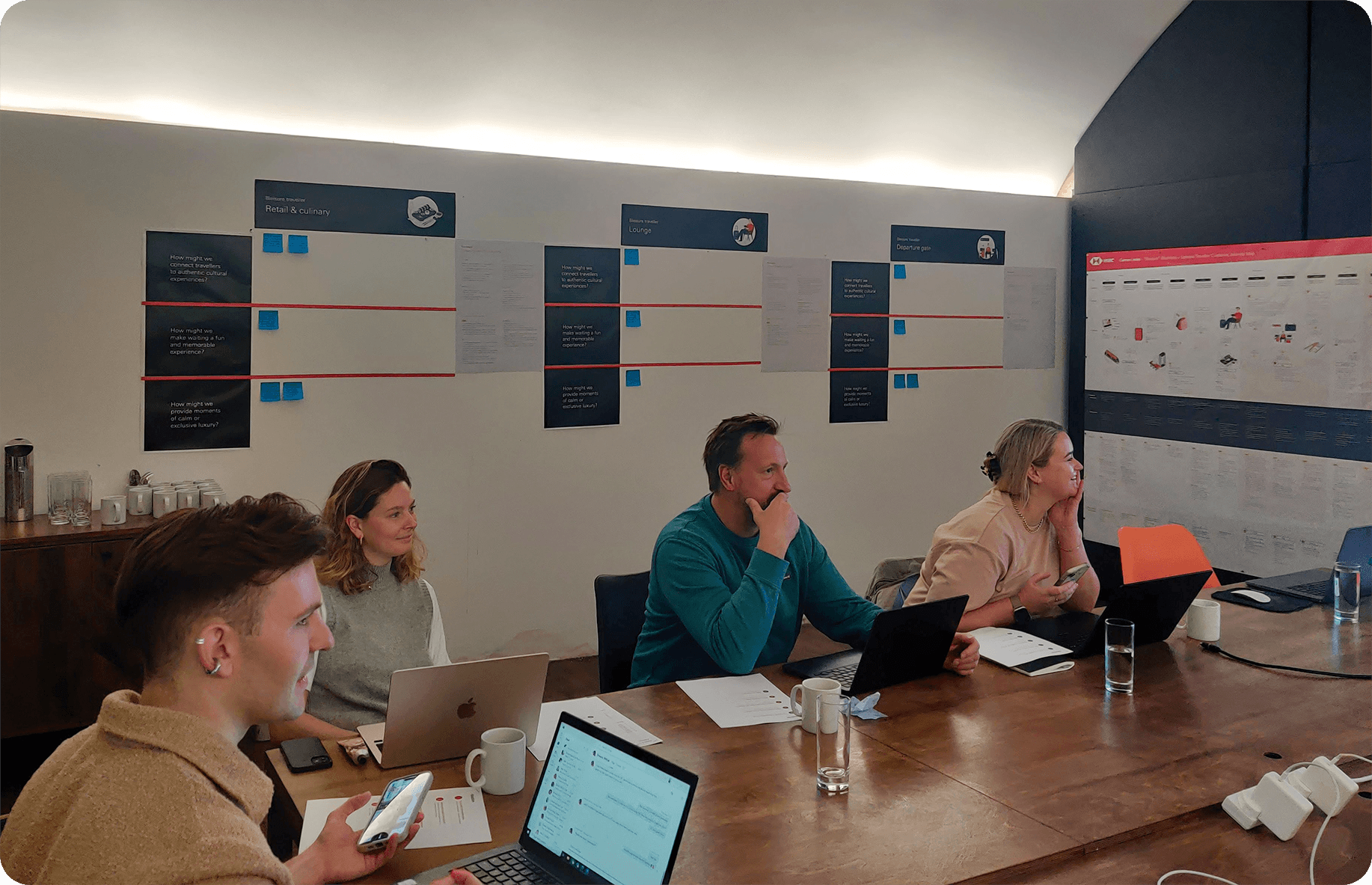
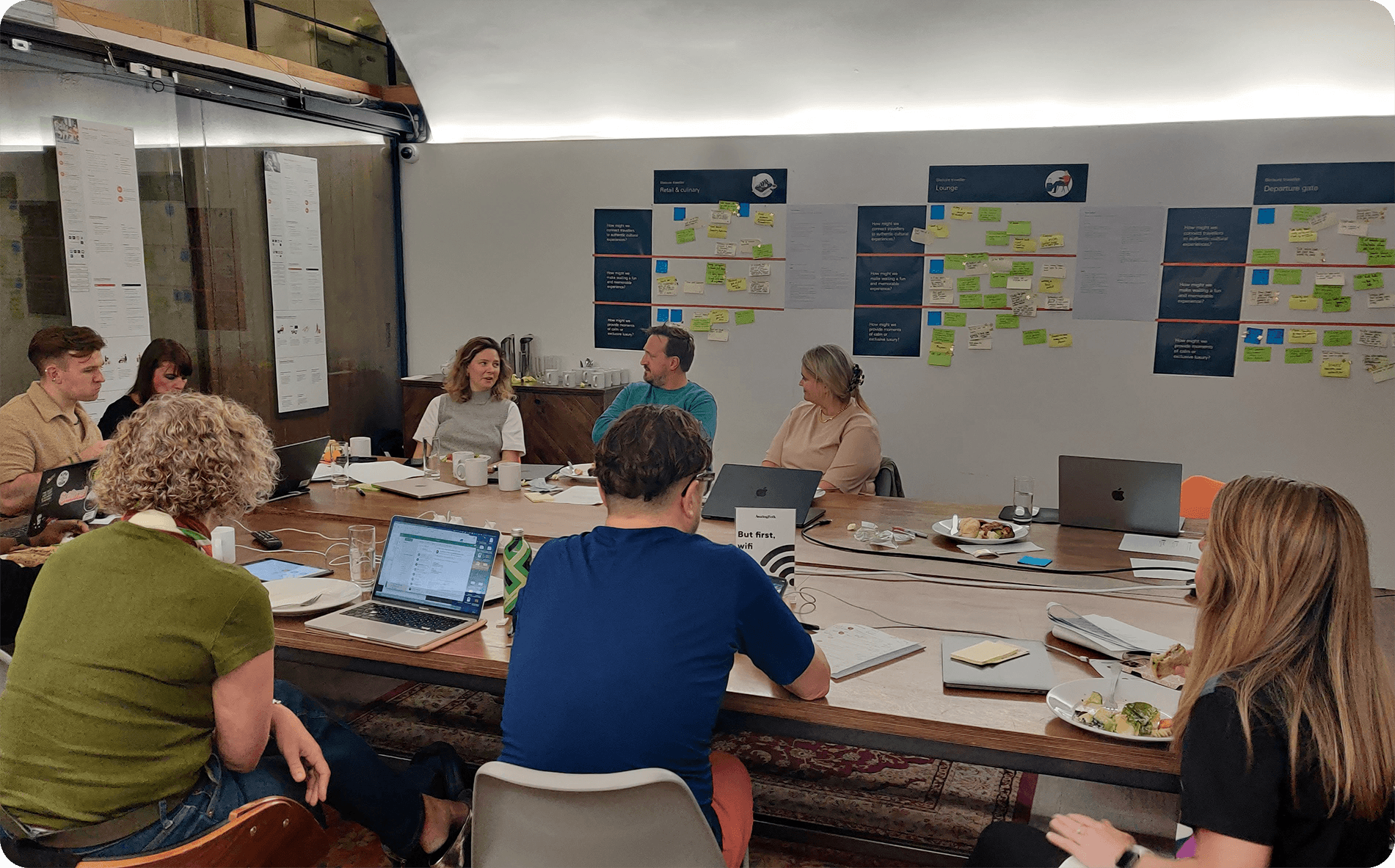
Client ideation & prioritisation workshop with journey map in the background.
HSBC had restructured its airport advertising investment around a tiered model ranking airports by brand resonance, but had never validated how mass-affluent travellers actually experienced the airport journey or where they were most receptive to brand engagement. Existing media placements were based on internal assumption. I was brought in to replace that assumption with evidence and translate it into a usable decision-making tool.
I led the project end to end and was the primary point of contact with HSBC’s Global Brand leadership team, covering:
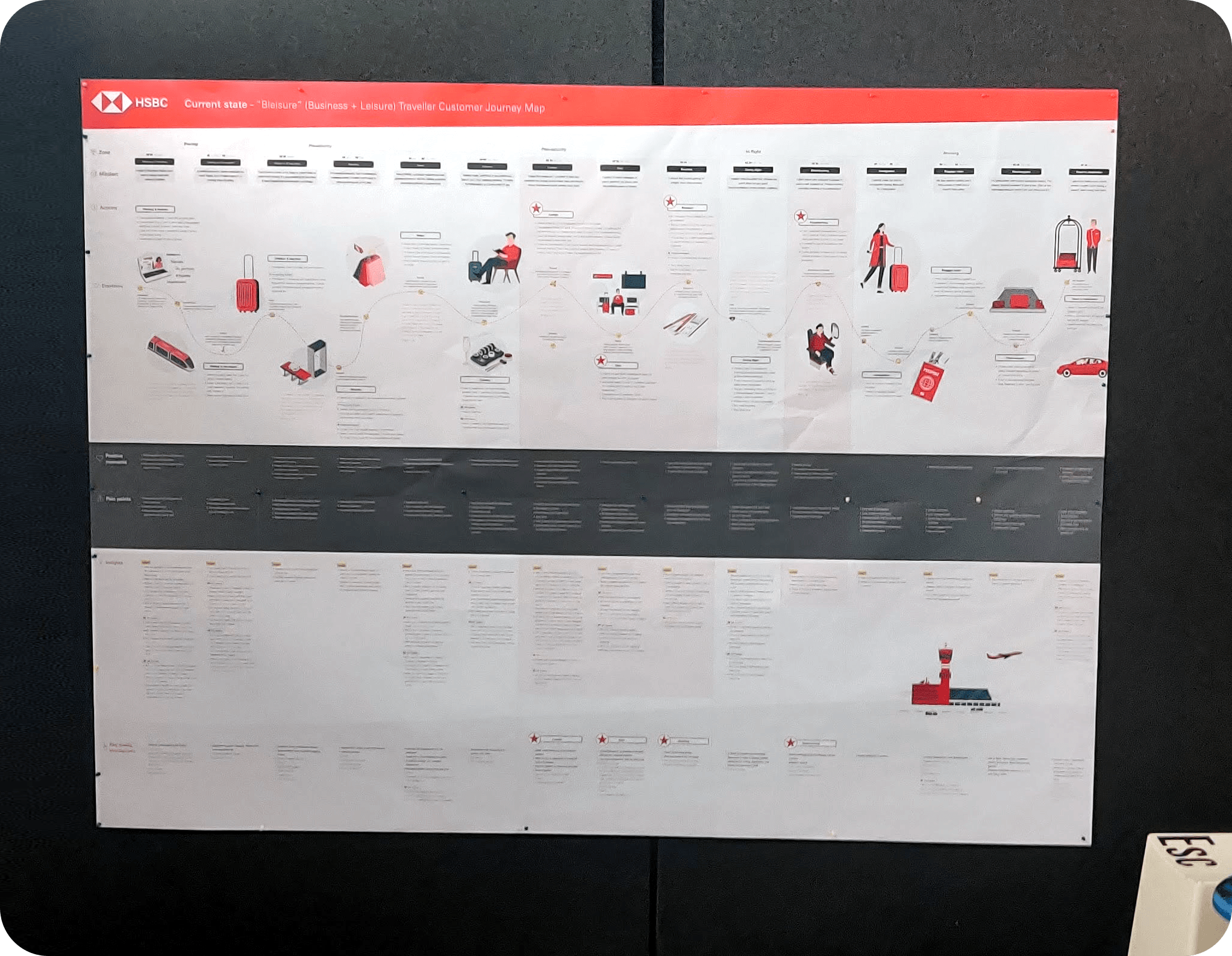
Journey maps from two personas
Mixed-methods study: in-depth qualitative interviews with six participants per market, triangulated against a quantitative survey of 1,200 respondents across a wider set of regions, both recruited via a specialist research panel. Discussion guides used open, non-leading questions and unprompted recall techniques to surface genuine behaviour rather than validate existing assumptions.
Thematic analysis using a structured framework matrix, cross-referenced across markets and traveller types. A second researcher cross-checked interpretation throughout to reduce single-researcher bias. Qualitative patterns were confirmed at scale against the quantitative data rather than treated as standalone conclusions.
The quantitative survey launched before qualitative analysis was complete due to project timelines. This was a deliberate trade-off: both instruments were built from the same thematic structure, so the survey could validate emerging patterns at scale without waiting on full analysis. Both streams delivered usable findings within the project window.
Co-creation workshop with the client to generate creative opportunities from the findings.
The research significantly challenged the client’s existing assumptions about traveller behaviour, financial motivations and emotional engagement across the journey. In several cases, the touchpoints HSBC had previously prioritised were among the least receptive moments in the journey, while higher-value opportunities were going unused.
The findings from this research are confidential to the client and are not included in this summary.
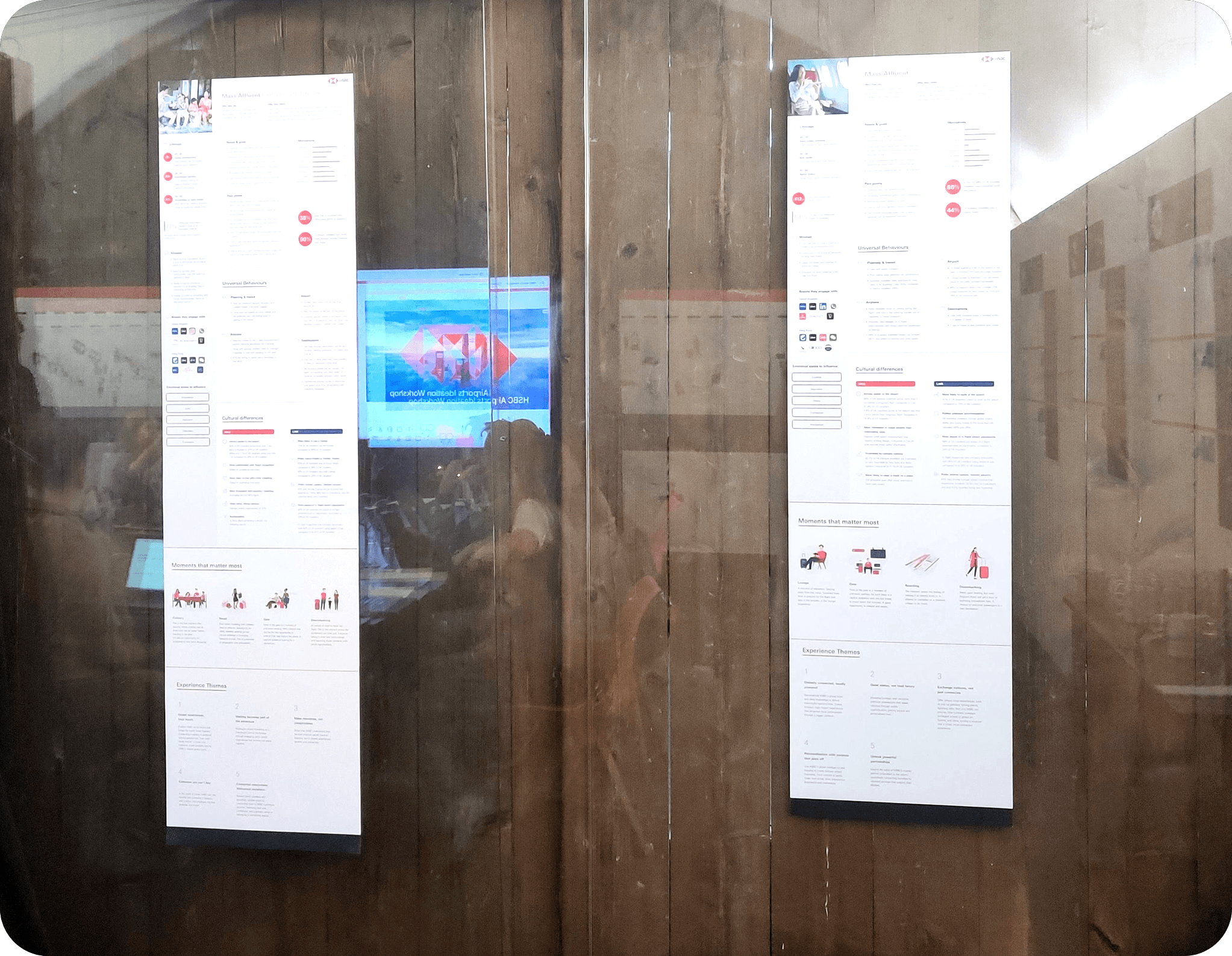
I developed two behavioural personas based on observed travel patterns rather than demographics. A key insight was that many travellers were the same person in different contexts – business trips and family travel produced entirely different behaviours, priorities and emotional states – which required a different framing to how the client had originally segmented their audience.
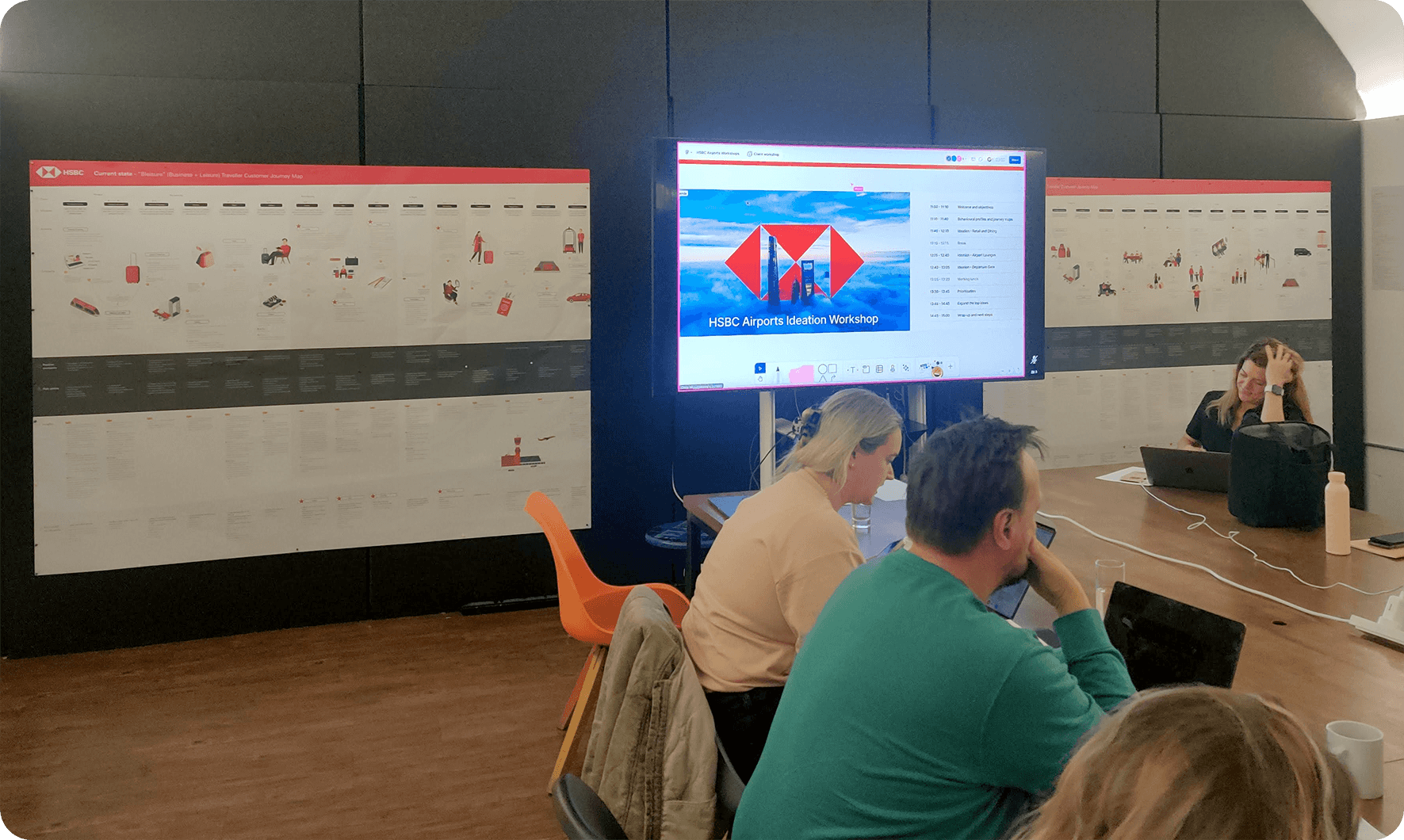
Each persona had a door-to-door journey map capturing emotional state, motivation and behaviour at every stage, with UK and Hong Kong nuances built in. Outputs were presented as a large-format wall map alongside a plain-language presentation deliberately stripped of research jargon.
Two behavioural personas based on observed travel patterns rather than demographics.
Journey map
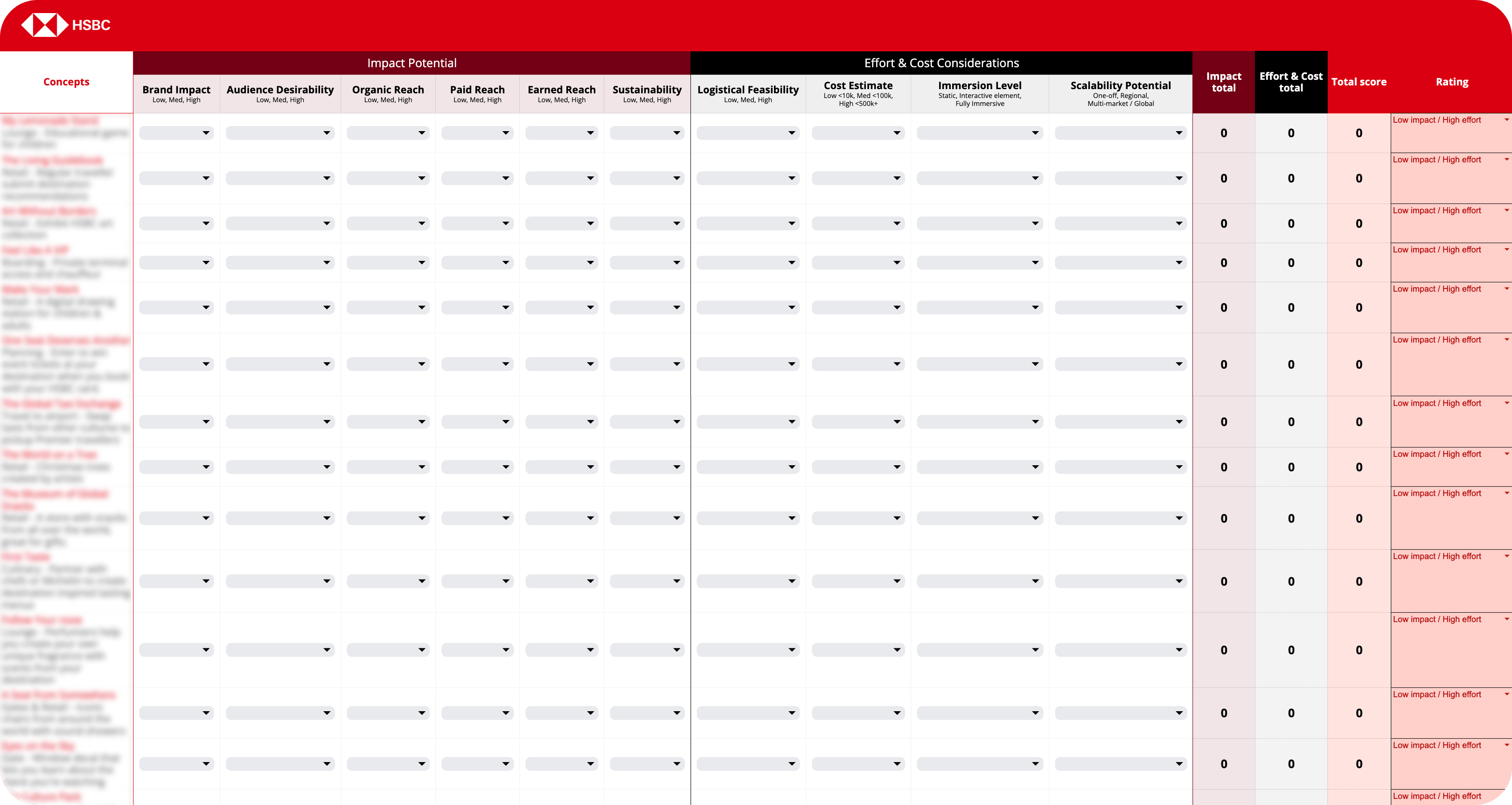
I facilitated a co-creation workshop with the client to generate creative opportunities from the findings, narrowing hundreds of initial ideas to a focused shortlist of 22. These were compiled into a multi-criteria prioritisation matrix designed for the client to score themselves rather than us scoring on their behalf – giving them ownership of the outcomes and making recommendations far more likely to be carried forward.
This was research-led strategy throughout: the intent was to give HSBC a robust evidence base to shape their plan and budget for the next five years, not a one-off creative output. The research directly influenced budget allocation, challenged existing media placements and produced a prioritised roadmap of brand experiences across their highest-value airports.
Multi-criteria prioritisation matrix
The evidence was clear enough to defend.
The hardest part of this project was not the research – it was presenting findings that directly contradicted established client investment decisions to senior brand leadership, and holding the position when challenged. The evidence was clear enough to defend.
Research
Service Design
UX
UI
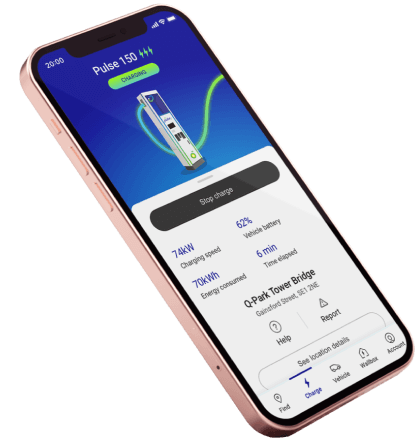
BP Pulse had two separate apps, 9 charging unit manufacturers with inconsistent interfaces, and non-standardised signage. I led research, service design and UX across the app, physical charging units and signage, expanding the brief beyond app consolidation to fix the full customer experience. I aligned engineering, procurement, signage and product teams throughout, and convinced the Head of Design to change the product direction based on research findings.
UX
UI
CRO
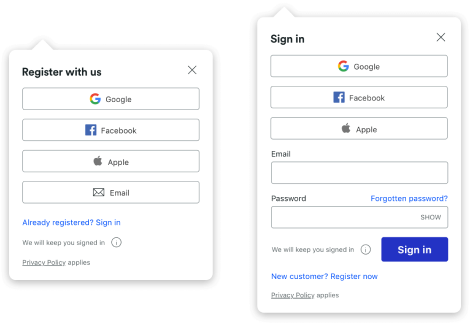
80% of Trainline customers were checking out as guests, limiting their ability to manage bookings and driving up contact centre costs. I led the design of a non-intrusive sign-in and registration system across UK and international platforms, testing multiple approaches to find interventions that increased logins without disrupting the booking flow. The result was a 59.2% increase in logged-in transactions on international mobile web and a 20% increase in registrations.